
How Senior Living Facilities Renovate Floors Without Relocating Residents
Last Updated: August 24, 2026
Quick Answer
A senior living facility is occupied around the clock, which makes full floor replacement difficult for residents and staff. A wear-layer renovation restores and protects resilient flooring such as VCT, vinyl, and linoleum room by room or wing by wing, usually without requiring residents to leave the building. It can be applied as a clear finish that helps end the strip-and-wax cycle or as a color finish that creates a different visual appearance. Renovation typically costs roughly $3 to $6 per square foot and involves far less downtime and demolition than full replacement. Below, we explain both options, what the process involves, and where renovation may not be the right fit.
Why Is Floor Replacement So Disruptive in a Senior Living Facility?
Unlike a building that can close after hours, a senior living facility is occupied around the clock. Residents live there, staff move continuously through the building, and common areas cannot simply disappear from daily use for a week. Full replacement means tearing out flooring, running equipment, and managing dust and noise in a building where the people walking those halls every day can't simply be relocated while the work happens. That alone takes traditional replacement off the table for a lot of facilities, not because the floor doesn't need help, but because the disruption isn't worth it.
Meanwhile, the strip-and-wax cycle most facilities run on doesn't solve the underlying problem either. It's labor-intensive, it requires repeated chemical use in a building with vulnerable residents, and it never actually improves the floor. It just resets the clock every three to six months.
What Are the Floor Renovation Options for Senior Living Facilities?
There's more chemistry in a floor coating than most people realize, and for senior living specifically, that chemistry gives you two real options depending on what the floor needs to do for you.
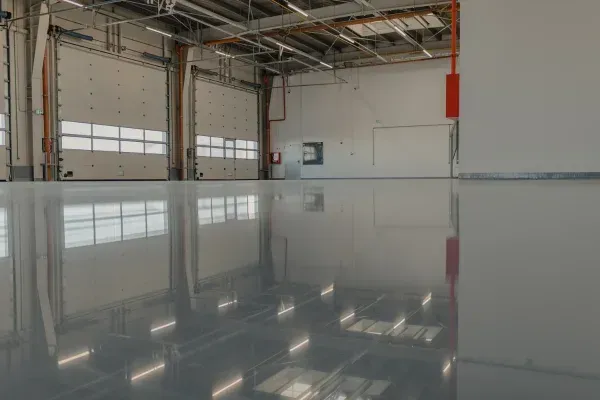
- Clear wear-layer finish: Restores and protects the floor you already have without changing how it looks. This is the right call when the floor is structurally fine but tired from years of strip-and-wax, and the priority is ending the recurring strip-and-wax cycle.
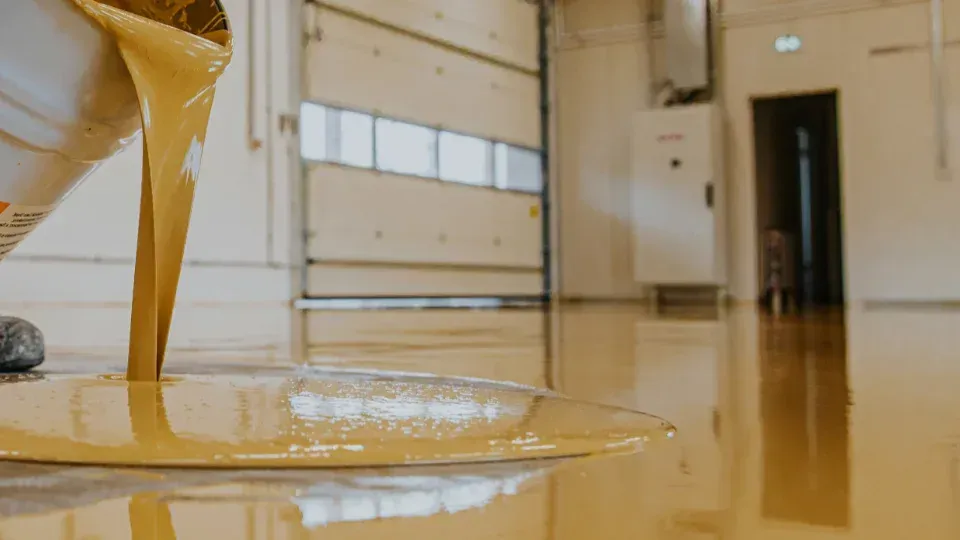
- Color finish:
Changes the look of the floor and can be used to create visually distinct zones by wing or floor. Custom Coatings has not yet completed a senior living project specifically centered on color-coded wayfinding, but the system gives facilities an option to explore with their design, accessibility, and resident-care teams.
Is This Floor System Safe for Residents With Mobility Concerns?
Slip-resistant additives can be incorporated into the topcoat for senior living environments. Custom Coatings uses products that meet applicable ADA slip-resistance guidelines. The additive is not visually noticeable, although its traction can be felt underfoot. The exact system should be reviewed against the facility’s mobility, walker, wheelchair, and fall-risk requirements before installation.
What Does the Renovation Process Look Like in an Occupied Building?
We don't give vague answers here. You should know exactly what's happening and when. The process runs in three stages, completed room by room or wing by wing:
- Contamination removal: Old wax, coatings, and residue removed without harsh chemical stripping.
- Mechanical surface prep: Light mechanical sanding, no dust-heavy grinding, which is an important detail in a building with residents who have respiratory sensitivities.
- Polyurethane wear-layer application: One to two coats, depending on substrate and finish. A treated zone is typically walkable within 24 hours or less.
Because there's no demolition or equipment removal, work can be sequenced by wing or by floor without requiring residents to be moved out of the building. How large those sections are depends on the facility. Where there is room to route residents around the work, larger areas can be done at once. Where there isn't, the work is split into smaller areas or several visits so no one is displaced. That sequencing flexibility is often the deciding factor for facilities that have ruled out replacement entirely.
How Does the Cost Compare to Strip-and-Wax or Full Replacement?
The clearest comparison is renovation against what a facility is already spending on strip-and-wax. The annual cost of that cycle is roughly equal to a one-time renovation that then lasts three or more years before its first recoat. Year one costs about what's already being spent. After the initial renovation, facilities can avoid much of the recurring labor, chemical use, and downtime associated with repeated strip-and-wax cycles for several years before recoating is needed.
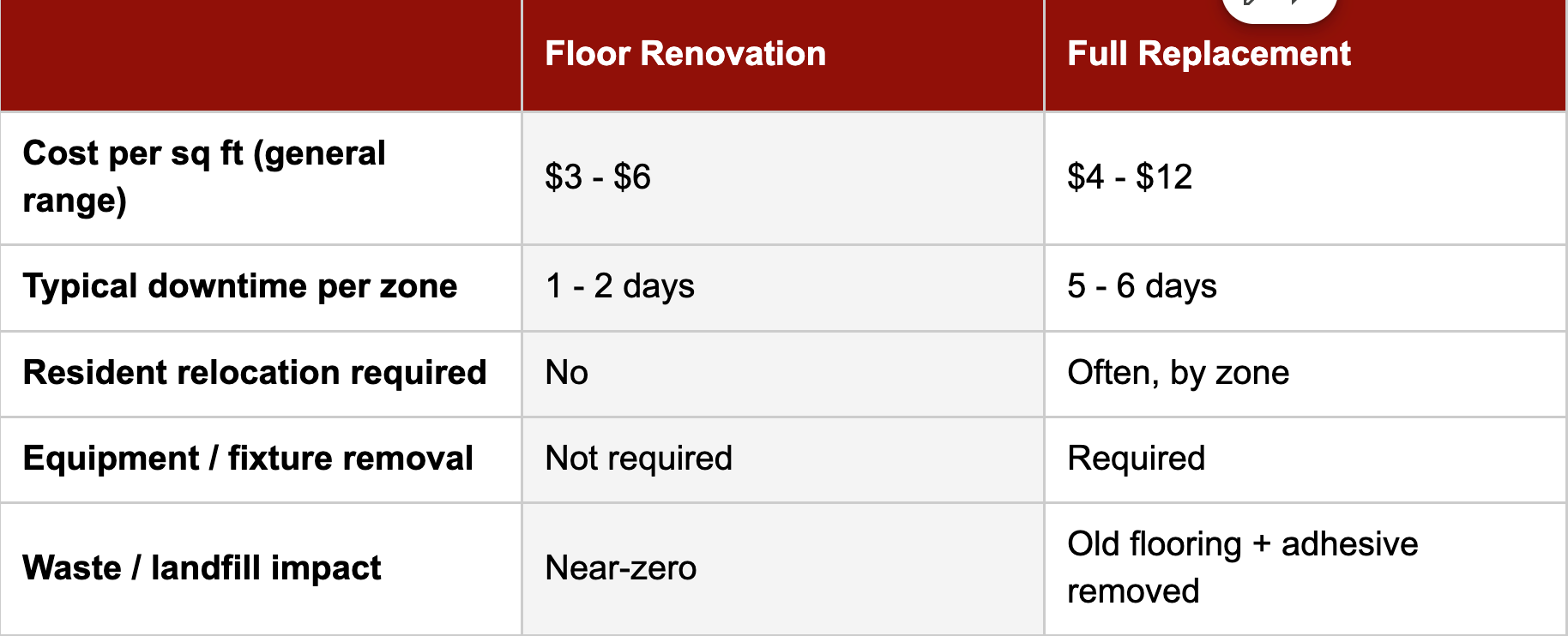
Against full replacement, the gap is even more pronounced given the disruption involved. Verify current local pricing before budgeting, but typical ranges are:
- Replacement: roughly $4 to $12 per square foot, 5 to 6 days of downtime per zone, plus equipment removal and landfill disposal.
- Renovation: roughly $3 to $6 per square foot, 1 to 2 days, no equipment removal, near-zero waste.
Renovation vs. Replacement: A Side-by-Side Comparison
Where Floor Renovation Isn't the Right Fit
We don't leave a job until it's right, and that starts with being honest about whether it's the right job. This system is built for resilient flooring that's worn but structurally sound, like VCT, linoleum, sheet vinyl, and rubber. It's not designed for outdoor surfaces, carpet, or areas with active moisture intrusion underneath, and it won't fix a subfloor that's already failing. If a facility has flooring with visible seam lines or damage that needs to be visually hidden rather than just sealed, a color or chip-broadcast finish handles that better than a clear coat alone.
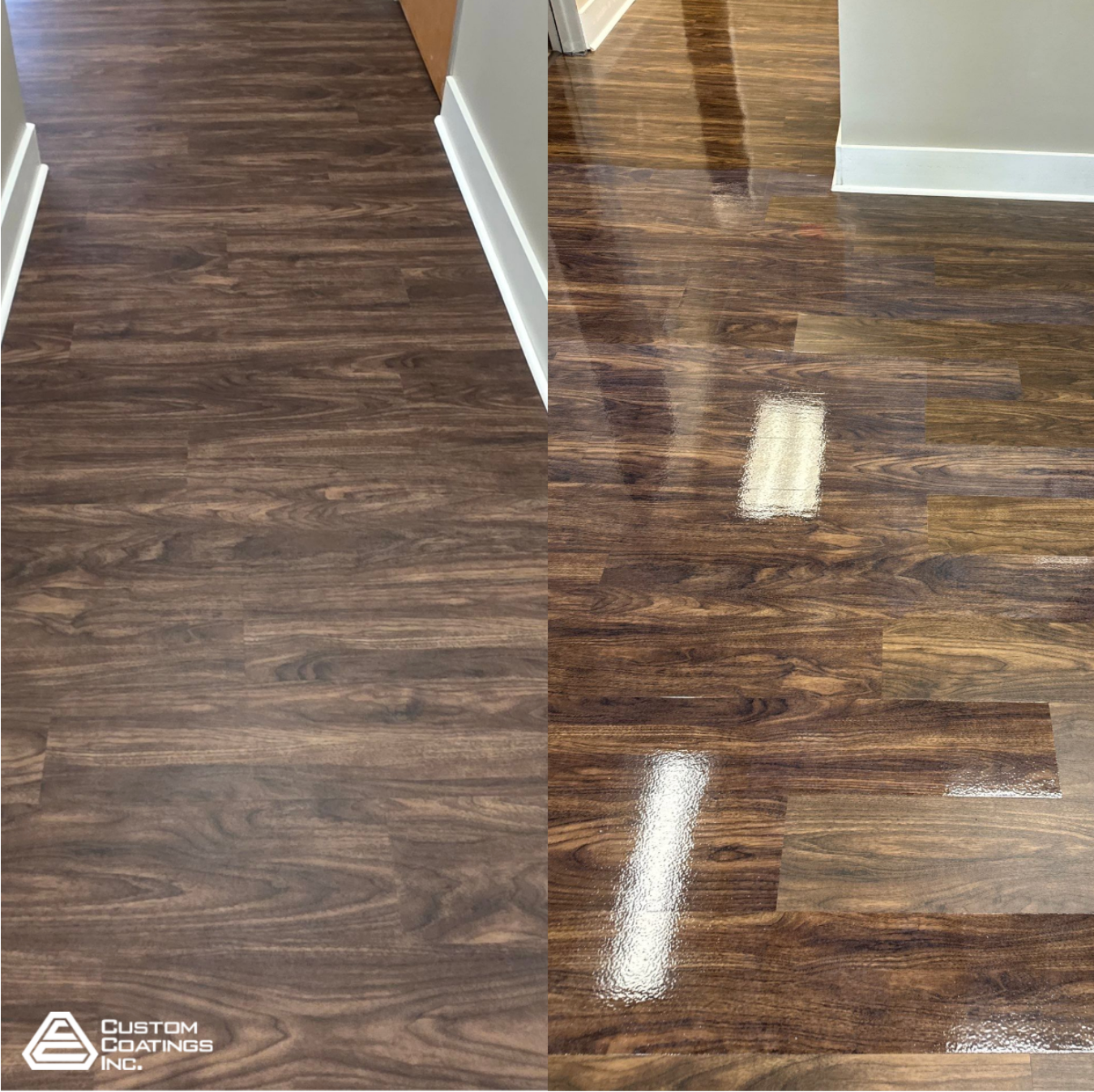
Floor Renovation Before & After
A floor with a defective or damaged original finish before and after the application of a renovation coating system.
Frequently Asked Questions
Q. Do residents need to be moved out during the work?
A full relocation is typically not required. Work is sequenced by room, wing, or floor so residents can remain in the building, although they may be temporarily routed away from the active work area.
Q. Can color be used to create distinct zones in a memory-care facility?
Yes. A color finish can create visually distinct zones by wing or floor. Custom Coatings has not yet completed a project specifically using this system for memory-care wayfinding, so the color plan should be developed with the facility’s design and resident-care teams.
Q. How long before a treated area can reopen?
A treated zone is typically walkable within 24 hours. Exact reopening time is confirmed with the facility based on the selected system, site conditions, and scheduling needs.
About Custom Coatings Inc.
Custom Coatings has been North Carolina's commercial coatings experts since 1991, working across the Southeast as what we call the Educated Coatings Contractor. There's a lot of technology in a single gallon of paint, or a single coat of wear layer, and we believe understanding it is what lets a facility make the right call, whether they end up working with us or not. If your facility is weighing a strip-and-wax cycle that never ends against a replacement project residents can't afford to live through, a no-cost floor assessment is the easiest way to see where renovation fits. Not ready for a full project? A walkthrough can still help you think it through.

Joe Brindle
Joe Brindle is the President and co-founder of Custom Coatings Inc., bringing more than 30 years of experience in commercial and industrial painting and coatings. Since founding the company in 1991, Joe has built extensive hands-on knowledge of coating systems, surface preparation, estimating, project planning, and product selection for commercial and industrial facilities throughout the Southeast.

SHARE THIS ARTICLE
OUR RECENT BLOG ARTICLES